

2026 Iowa Legislative Session Recap
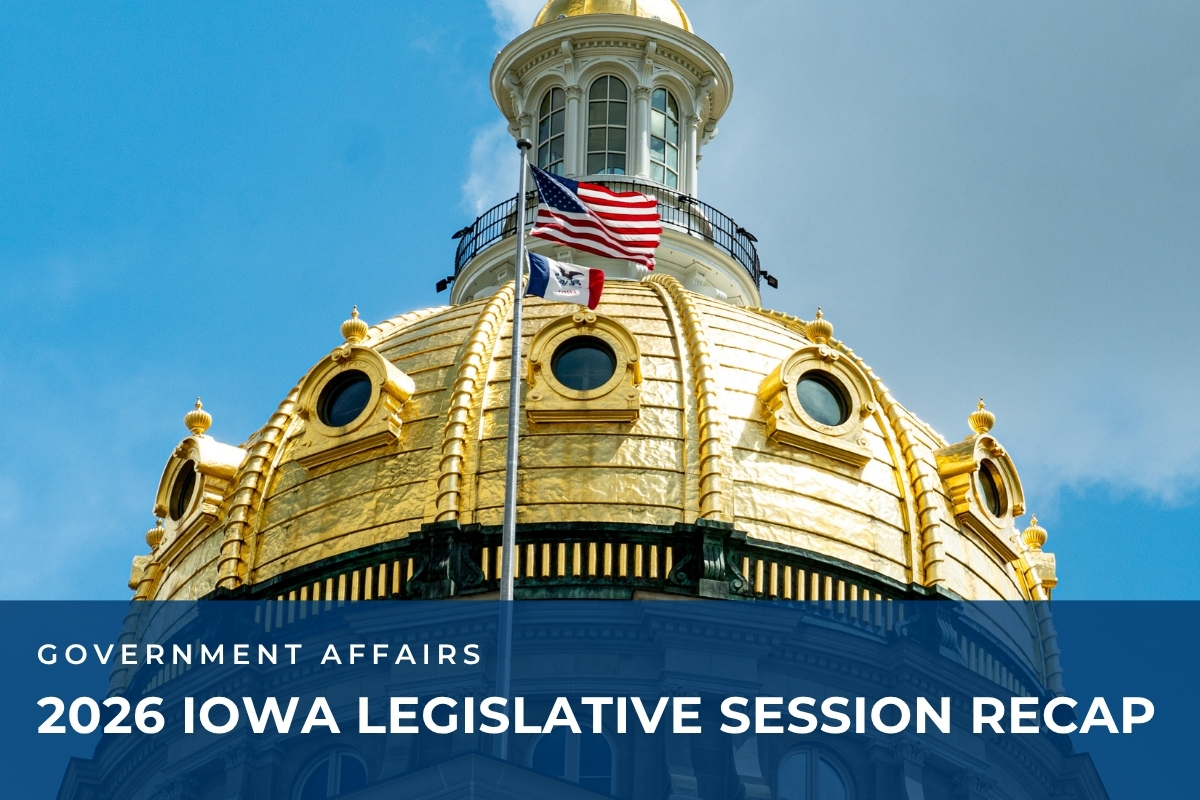
The Second Session of the 91st Iowa General Assembly adjourned on May 3, wrapping up a session defined by property tax reform, healthcare funding discussions, education policy changes, and several economic development initiatives. While the session was scheduled to conclude on April 21, lawmakers extended negotiations for nearly two additional weeks to finalize budget and policy agreements.
As the legislature completed its work, several major themes emerged, including fiscal restraint, workforce and business climate improvements, infrastructure investment, and continued reforms tied to education and economic development.
State Budget and Revenue Outlook
The March Revenue Estimating Conference projected Iowa will end Fiscal Year 2026 with approximately $8.11 billion in revenue, representing a 9.3 percent decrease from FY25. Revenues are expected to rebound modestly in FY27 to $8.47 billion, an increase of 4.4 percent over FY26.
Following the updated forecast, legislators approved a $9.452 billion state budget for FY26.
The extended session timeline reflected the challenge of balancing budget priorities while addressing large-scale policy initiatives, particularly property tax reform and Medicaid funding.
Governor Reynolds’ Legislative Priorities
During the Condition of the State address, Governor Kim Reynolds outlined a broad agenda focused on education, public health, and tax policy. Several key proposals were ultimately signed into law.
Charter School Changes
House File 2754 made significant updates to Iowa’s charter school system by:
· Designating charter schools as local education agencies for federal funding purposes
· Extending teacher salary supplements tied to state per-pupil funding
· Allowing charter school participation in public school extracurricular activities
· Creating an additional Educational Savings Account request period
Iowa Make America Healthy Again Initiative
House File 2676 advanced several health and wellness provisions, including:
· Restrictions on certain food dyes in school foods and beverages
· Authorization for over-the-counter ivermectin sales
· Limiting K-5 digital instruction to 60 minutes daily
· Requiring 30 minutes of physical activity for students each day
· Directing the state to seek a waiver for the summer EBT program
Property Tax Reform Takes Center Stage
Property tax reform remained one of the most closely watched issues of the session. Republican leadership in both chambers identified the issue as a top priority early in the year, and lawmakers ultimately reached a compromise during the final hours of the session through Senate File 2472.
Key provisions include:
· A 2 percent cap on the general services levy, excluding new valuation
· Reestablishment of the Mult residential property classification
· A 6 percent increase above the residential rate for multi-residential properties
· Reforms to tax increment financing (TIF)
· Shifting the burden of proof for property assessment increases above 10 percent
· Restrictions on bonding for general operations
· Reserve limitations tied to GASB recommendations
· Creation of FirstHome Iowa Accounts
The legislation also phases out homestead and business replacement tax credits previously used to buy down school foundation aid levies.
Medicaid Funding and HMO Tax Changes
To address a Medicaid funding gap, lawmakers approved a one-time increase on taxes applied to health maintenance organizations and managed care organizations.
The legislation retroactively raises the tax rate from 0.92 percent to 3.5 percent between January 1 and September 30, 2026. The increase is expected to generate approximately $123 million while allowing the state to secure matching federal funds before federal restrictions take effect later this year.
Additional language in the standings bill creates a tax credit mechanism that allows HMOs to recoup revenue losses over the next eight years with the goal of avoiding insurance premium increases for Iowa residents.
Constitutional Amendment on Income Tax Increases
The legislature also advanced Senate Joint Resolution 11 for a second consecutive General Assembly. The proposed constitutional amendment would require a two-thirds majority vote in both chambers for any future increase to Iowa’s individual income tax rates.
Because constitutional amendments in Iowa must pass two consecutive General Assemblies, the proposal will now appear on the November 2026 ballot for voter consideration.
Economic Development Highlights
Economic development legislation remained a major focus throughout the session, particularly around business expansion, infrastructure, workforce preparation, and housing.
IEDA Omnibus Bill
House File 2799 included several initiatives aimed at strengthening Iowa’s economic development tools:
· Creation of the Headquarters Expansion and Development for Growth and Employment Program
· Extension of the MEGA program sunset to 2030
· Establishment of the Business Incentives for Growth Program Training Fund
· Changes to the 260E program, limiting bond lengths to five years
· A study focused on the 260E program reform
· Direction to Iowa State University to produce a statewide load forecasting report
TIF Reform
Senate File 2472 also included substantial changes to tax increment financing policy by:
· Expanding the definition of economic development to include housing
· Limiting perpetual TIF district revenue usage to 60 percent
· Capping new TIF districts at 23 years
· Removing low-to-moderate income requirements
· Adjusting school levy participation options
Housing Renewal Program
House File 2772 formally codified the Housing Renewal Program under the Iowa Finance Authority.
Business Climate and Workforce Policy
Several measures impacting employers and workforce administration advanced during the session.
Unemployment Benefits
Senate File 2089 requires the Iowa Department of Workforce Development to allow claimants and employers to submit information separately before joint fact-finding interviews. Supporters argued the change would improve fairness and efficiency in the unemployment claims process.
GILTI Tax Changes
Senate File 2492 creates a state corporate income tax deduction for net controlled foreign corporation tested income, replacing the previous deduction tied to global intangible low-taxed income.
Infrastructure and Utility Investments
Infrastructure and utility policy also received attention during the session.
Public Utilities
Senate File 2304 allows utilities to implement a system enhancement charge to recover infrastructure upgrade costs outside of a traditional rate case process.
Water Quality Investments
Senate File 2484 appropriates $25 million to Central Iowa Water Works for nitrate removal facility upgrades, expanded water quality monitoring, additional treatment funding, and a loan program supporting rural community water infrastructure improvements.
Looking Ahead to 2027
With adjournment complete, Governor Reynolds has until June 2, 2026, to approve or veto legislation sent to her during the final days of session.
The First Session of the 92nd Iowa General Assembly is scheduled to convene on January 11, 2027. As implementation of major tax, economic development, and infrastructure policies begins, lawmakers and stakeholders across the state will continue evaluating the long-term impacts of this year’s legislative actions on Iowa communities, businesses, and taxpayers. Additional legislative information and bill text can be found through the Iowa Legislature website.
For more information, please contact:
Adrienne Miller
Director of Business Services & Advocacy
(319) 232-1156 ext. 4909
REACH OUT
Learn More About Grow Cedar Valley
If you have any questions, don’t hesitate to ask. We’re here and happy to help!